
NFL Betting Sheets 2026: UK Punter's Strategy Manual
The first time a mate from Sheffield pushed an American betting sheet across the table at me, he stared at it the way most British punters stare at a Welsh tax form. Four-digit numbers down the left, minuses and plusses scattered like punctuation, a column marked "ML" he assumed was a typo for "MMR". I have been reading these sheets for eight years and I still remember how alien they felt before someone walked me through them.
Here is the heart of the problem. A US printable sheet speaks in rotation numbers and point spreads quoted at minus 110. A UK Sky Bet coupon speaks in handicap lines quoted at 10/11. Same product, same maths, two different vocabularies. There are 13 million NFL fans in the UK, around 4 million of them classed as avid, and a startling slice of that crowd is placing real money on lines they cannot fully decode.
The NFL's UK boss Henry Hodgson has been blunt about why interest keeps climbing: growing the league internationally is a major strategic priority, live games in London have run since 2007, and ticket demand has never been stronger. That growth has dragged newcomers into the betting market without dragging the educational content with them.
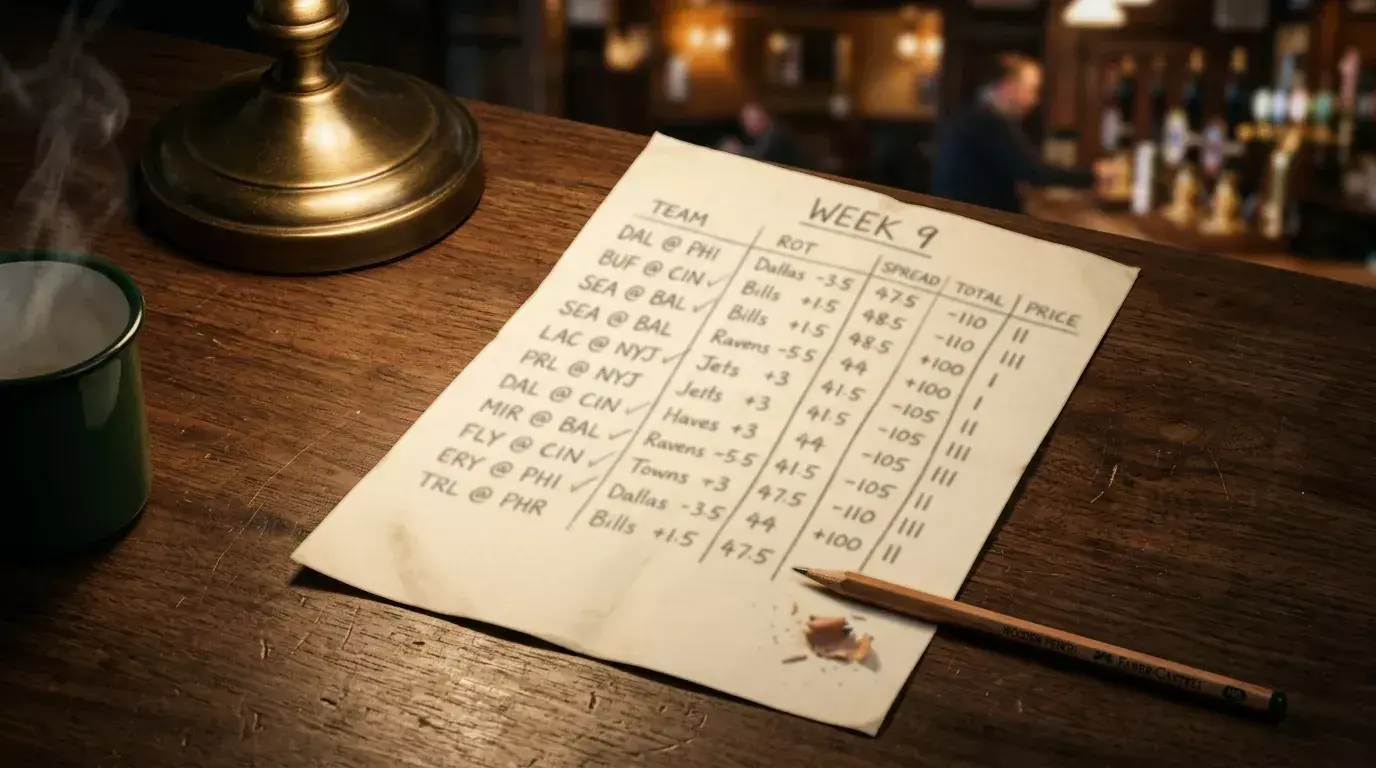
Sheet — a single-page document listing every NFL game in a given week with its rotation number, kickoff, spread, total and moneyline. In the UK we sometimes call it a "coupon", though that word implies a bookmaker-branded version rather than a neutral analysts' grid.
Handicap — the UK term for what Americans call a point spread. A handicap of −7 on the favourite means the favourite must win by eight or more for the bet to land. Mathematically identical to a US spread, dressed in different odds notation.
What follows is a working punter's manual. I translate every column of a typical US sheet into UK reading, drill into the maths of key numbers 3 and 7, walk through a Tuesday-to-Monday workflow, and flag the seven mistakes I see most often when British bettors first step onto American football.
What This Field Guide Covers in 60 Seconds
- A UK NFL betting sheet is a single-page weekly grid of rotation numbers, kickoffs in GMT or BST, spreads, totals and moneylines — built for offline reading and ATS tracking.
- Translation rule that matters most: a US spread of −7 equals a UK handicap of −7, but the price beside it shifts from −110 to roughly 10/11 in fractional odds.
- Three numbers fix nearly half of all NFL margins: 15% of games since 1989 land exactly on 3 points, around 9% on 7, and you must win 52.38% of bets at −110 just to break even.
- The British workflow runs Tuesday print, Wednesday shop, Thursday confirm, Sunday execute, Monday log — and every step lives on the sheet rather than inside the bookmaker's app.
- Pick a UKGC-licensed bookmaker, use a printable template with both decimal and fractional columns, and treat the sheet as a discipline tool rather than a prediction engine.
What an NFL Betting Sheet Actually Is
I keep a folder on my desk labelled "Week 9 to Week 17, 2024". Inside sit thirteen creased sheets, each one annotated in pencil with ticks, crosses and the occasional swear word. That folder is the most useful piece of betting kit I own, and it cost nothing.
An NFL betting sheet is a single-page document — paper or digital — that summarises an entire week of fixtures in a grid you can read at a glance. One row per game. Columns for rotation numbers, kickoff time, spread or handicap, total, moneyline, and an empty space for your own notes. The reason I still print one every Tuesday despite working with three monitors is that a sheet forces you to see the whole slate at once rather than diving into a single match inside an app.
Origin of the Printable Line Sheet
The line sheet started life in Las Vegas as the daily one-pager that runners carried between sportsbooks. The format crossed into consumer hands through Don Best feeds and Covers.com print sheets in the early 2000s. By the time it reached British punters, three things had changed: kickoffs were quoted in UK time, fractional odds began appearing in parallel columns, and the moneyline column got a fresh name — "match winner" — to suit the local vocabulary.
What a UK Punter Actually Marks
The sheet stops being passive reference the moment you pick up a pencil. My weekly markings look the same every time. A tick beside any game I have already backed. A small triangle next to games on a watch list — usually because I want to see Thursday morning line movement before committing. A cross through any game I have ruled out. A circled line price means it is the best I have seen across the UKGC market.
Sharp bettors, according to the Betvisors analytics collective, typically wager on only 20 to 30% of available games — they go after spots with genuine edge rather than splattering small stakes across the full Sunday slate. The sheet is what makes that discipline visible.
Sheet Against In-App Bet Slip
Phones have an obvious advantage for actually placing the bet. They have a less obvious disadvantage for picking the bet. The bookmaker's interface is designed to surface emotionally-charged options: a flashing same-game accumulator banner, a "bet again" prompt next to your last winning slip, an in-play prompt the moment a quarterback throws a pick.
The UK remote betting market generated £2.6 billion in gross gambling yield over 2024-25, with online real-event GGY growing 7% year-on-year. A meaningful chunk of that growth comes from app-driven impulse betting — precisely the behaviour a paper sheet pushes back against. I treat the sheet as the strategic layer and the app as the execution layer.
A common misunderstanding: a betting sheet is not a tipster's pick sheet. It contains the market's lines, not opinions about which side will win. Any prediction lives in your pencil marks, not in the printed numbers.
| Team | Spread (US) | Handicap (UK) | American | Decimal | Fractional |
|---|---|---|---|---|---|
| Patriots | −7.5 | −7.5 | −110 | 1.91 | 10/11 |
| Dolphins | +7.5 | +7.5 | −110 | 1.91 | 10/11 |
US sheet layout
- Rotation numbers in the leftmost column
- Kickoff in Eastern Time
- Spread paired with American odds (−110)
- Moneyline column labelled "ML"
UK-friendly layout
- Rotation numbers retained but smaller
- Kickoff in GMT or BST
- Handicap paired with fractional and decimal columns
- Moneyline relabelled "match winner"
Anatomy of a Betting Sheet, Column by Column
Ask a new punter what scares them about an American line sheet and they almost always point at the same thing: the leftmost column. Four-digit numbers with no obvious pattern, repeated in pairs.

Rotation Numbers Decoded
Every NFL game carries two rotation numbers — one for the favourite, one for the underdog. They run sequentially through the week and are synchronised across the industry through Las Vegas wholesalers. The rule I drum into anyone I coach: the favourite always carries the higher rotation number, and the favourite is always the even-numbered side. So a Bills versus Dolphins fixture might read 505 Dolphins, 506 Bills. Knowing this means you can call a bet by its rotation number alone over a noisy phone line — which is exactly why the system was invented before mobile apps.
Reading the Spread Row
"Bills −7.5 −110" reads as: Bills favoured by 7.5 points, priced at minus 110 American odds. Translate that and you get Bills handicap −7.5 at 10/11 fractional, decimal 1.91. The 7.5 is the points the Bills must cover. The minus 110 is the price. Punters new to the format collapse those into one figure and assume "−110" is the spread. It is not — it is the cost.
Totals Row, Over and Under
Below or beside the spread sits the total — sometimes called over/under. A typical entry reads "O/U 47.5 −110". You are betting whether the combined final score will exceed or fall below 47.5 points. UK bookmakers price this identically in maths but quote it differently in style — Sky Bet might show "Over 47.5 at 10/11" rather than "−110".
Moneyline Column
The moneyline is the straight match-winner market. A Bills price of −190 means you must stake £190 to win £100 on Buffalo. A Dolphins price of +160 means a £100 stake returns £160 profit. In fractional this becomes Bills 10/19 and Dolphins 8/5. The moneyline column is where the sharpest line shopping pays off — UK bookmakers diverge on match-winner prices more than they do on spreads.
Customising the Edge Column
The right-most column on every decent sheet is blank — left there for you. I fill mine with three values: my model's estimated fair line, the difference between fair line and market line, and a tier rating from A to C. A tier-A play is a game where model and market disagree by at least one and a half points. Anything less is noise.
For the full breakdown of how each row signals sharp money movement and what UK time-zone conversions look like, I have written a longer companion guide on reading an NFL line sheet column by column.
UK Against US Terminology, Side by Side
A Reading-based reader once emailed me to say he had been arguing with an American podcaster for ten minutes before realising they were using two different words for the same bet. He thought he was disagreeing about strategy. He was disagreeing about vocabulary.
British and American gambling languages drifted apart over decades. The UK market grew up around horse racing, fractional odds and bookmaker shops; the US market grew up around point spreads, casinos and back-room runners. When American football arrived in Britain, the two vocabularies collided. You will see both sets of terms on the same page, sometimes in the same sentence on a UK bookmaker's NFL coupon.

UK term
- Handicap
- Match winner / outright
- Accumulator (or "acca")
- No direct UK equivalent — usually labelled "teaser"
- Specials / request-a-bet / bet builder
- Overround
- Void
- Bookmaker
- Stake
US term
- Point spread
- Moneyline
- Parlay
- Teaser
- Prop bet
- Juice / vig
- Push
- Sportsbook
- Wager
A handicap of −7 in the UK and a spread of −7 in the US are mathematically identical: the favoured side must win by eight to cover. What is not interchangeable is the price beside the line. US sheets quote it as −110 American; UK sheets quote it as 10/11 fractional or 1.91 decimal.
Teaser bets do not have a clean UK equivalent. A teaser shifts the spread in your favour by a fixed amount — usually six points — in exchange for a worse price across two or more legs. British bookmakers occasionally offer "alt-handicap" products on similar principles, but the multi-leg teaser is a US-native bet.
"Push" and "void" describe the same outcome. A push happens when the final margin lands exactly on the spread — Bills −3 in a 24-21 win. In the US the bet "pushes" and you get your stake back. In the UK it is called a "void". Identical refund.
Overround — the bookmaker's built-in margin, expressed as the amount by which the sum of implied probabilities across all outcomes exceeds 100%. The US equivalent is "juice" or "vig", mathematically the same number wearing a different name.
If you memorise four pairings, make them handicap-spread, accumulator-parlay, match winner-moneyline, and overround-vig. Those four cover roughly nine out of every ten conversations you will have with American friends who think they are speaking your language.
American, Decimal and Fractional Odds on One Page
Open Sky Bet on one screen and ESPN's NFL odds page on another, then look at the same fixture. Sky Bet shows the favourite at 5/6. ESPN shows them at −120. The decimal converter on a third tab tells you both translate to 1.83. Three numbers for the same price. The market speaks in three accents.

American to Decimal
For positive American odds: divide by 100, then add 1. So +150 becomes (150 ÷ 100) + 1 = 2.50. A £10 stake at +150 returns £25 total, £15 profit.
For negative American odds: divide 100 by the absolute value, then add 1. So −190 becomes (100 ÷ 190) + 1 = 1.526. A £10 stake at −190 returns £15.26 total, £5.26 profit.
Decimal to Fractional
Take the decimal, subtract 1, express as a vulgar fraction. A decimal of 2.50 becomes 1.50, which is 3/2 or 6/4 in UK bookmaker rounding. A decimal of 1.526 becomes 0.526, roughly 10/19. UK bookmakers round to recognised anchors like 5/4, 11/10, 10/11, 5/6 and 1/2.
Quick-look Conversion Table
| American | Decimal | Fractional | Implied probability |
|---|---|---|---|
| +150 | 2.50 | 6/4 | 40.0% |
| +100 | 2.00 | 1/1 (evens) | 50.0% |
| −110 | 1.91 | 10/11 | 52.38% |
| −120 | 1.83 | 5/6 | 54.55% |
| −190 | 1.526 | 10/19 | 65.52% |
Worked example: £25 stake on a handicap of −6.5 at 10/11
Step 1. The fractional 10/11 says we win 10 units profit for every 11 units staked.
Step 2. Profit on £25 = (10 ÷ 11) × £25 = £22.73.
Step 3. Total returns including stake = £25 + £22.73 = £47.73.
Step 4. Implied probability: 11 ÷ (10 + 11) = 52.38%. To break even over a season you must win 52.38% of handicap bets at this price.
That 52.38% figure is the dividing line between a profitable bettor and a losing one at the standard NFL spread price. Most casual punters never bother calculating it. The handful who do tend to be the ones still placing bets five years later.
American
Default US notation. Negative for favourites, positive for underdogs.
Decimal
Includes stake. Multiply your stake by the decimal to find total returns.
Fractional
UK standard. Profit-to-stake ratio expressed as a vulgar fraction.
Implied probability
Decimal odds inverted as a percentage. The number you compare against your own model.
Keep all three formats on the printable sheet side by side, and never trust a single-format display. A deeper formula-by-formula walkthrough lives in the cluster article on NFL odds conversion for UK punters, which covers overround, no-vig pricing and the mental shortcuts UK bookmakers actually use.
The Two Numbers That Bend Every NFL Spread
If I had a single piece of NFL betting wisdom to tattoo on my forearm, it would be this: more than 15% of all NFL games since 1989 have finished with exactly a 3-point margin — almost twice as common as the next most-frequent margin. The number 3 is the gravitational centre of the entire spread market.

Why 3 and 7 Dominate
NFL scoring is built from two prime components — the field goal (3 points) and the touchdown plus extra point (7 points). Coaches play to win by the smallest margin possible in close games, settling for field goals and kneel-downs, and the margin distribution bulges sharply at 3 and again at 7.
Since the 2003 season the numbers are tighter still: 14.8% of all games finish with a 3-point margin, roughly 9% end with a 7-point margin. Nearly a quarter of all NFL outcomes land on just those two integers — no other major sport concentrates results this severely.
The 2015 Extra-Point Rule Shift
One small rule change quietly redistributed the margin map. Before 2015, the extra point was kicked from the 2-yard line and converted at a 95.2% rate. From 2015 the kick moved back to the 15-yard line and the conversion rate dropped to 90.7%. That pushed about 2.4% of games away from the classic 7-point margin and into the 6 and 8-point columns.
The wider field-goal effect runs in the same direction: 18.7% of games end with a field-goal margin separating the two teams. When analysts say "the line is sitting on a key number", they mean precisely this — the market has stopped on a value where the margin distribution spikes.
Buying Half-Points in Practice
UK bookmakers rarely advertise "buy points" as a product the way American books do, but the practical effect still applies. Taking Buffalo at −2.5 instead of −3 buys protection against the single most common margin in football. The cost is a worse price — perhaps 10/11 drops to 4/5 — and the question is whether that price degradation outweighs the push protection.
My rule of thumb: half-point movement on or off the number 3 is worth roughly 25 cents in American pricing terms. Movement off 7 is worth slightly less. Movement off 10 — the "two-score" threshold — is worth less again. Anything off a non-key number is mostly negligible.
Key number 3
15% of games since 1989. The dominant margin in NFL betting and the most expensive half-point to cross.
Key number 7
Around 9% of games. The second pillar of NFL margin distribution, slightly eroded since the 2015 extra-point change.
Key number 10
A secondary cluster — the "two-score" threshold that signals a game is effectively out of reach for the trailing side.
Key number 6
The quietly growing margin. Worth more than it used to be because 2015 sent some former 7-point games into the 6-point column.
Since 1989, no NFL season has gone by without at least one Super Bowl Sunday landing on a 3-point margin in its conference championship games. The number is so persistent that Las Vegas books often refuse to move spreads past 3 for fear of being caught on both sides.
Memorise three figures: 3 points decides 15% of games, 7 points decides 9%, and to break even at 10/11 you must win 52.38% of the time. Every spread bet should be tested against those three numbers before the stake is confirmed.
The full distribution — what 4-point, 6-point and 8-point margins do to your expected return, plus a season-by-season breakdown of how 2015 changed everything — lives in my deeper companion piece on NFL key numbers for UK bettors.
Where NFL Betting Sits Inside the British Market
Walk into any pub in Camden during a Sunday NFL game and you will see something that did not exist fifteen years ago — a room of Brits, in jerseys of teams whose cities they have never visited, arguing about whether the Eagles should have gone for it on fourth down. That argument is the visible tip of one of the most interesting growth corners of British sports betting.
UK Betting Market in Numbers
The whole British gambling industry generated £12.6 billion in gross gambling yield over April 2024 to March 2025 — a 9.3% increase. Inside that, remote betting alone accounted for £2.6 billion, with football contributing £1.3 billion and horse racing £766.7 million. The UK currently holds 24.4 million active gambling accounts — a remarkable density for a country of 67 million.
The online slice is growing faster than the high street. Online real-event betting GGY reached £596 million in Q4 2024-25, up 5%. Meanwhile the country's physical betting shop count fell for the eleventh consecutive period to 5,825 outlets. Money is migrating from the high street to the phone, and minority sports like NFL are riding that migration disproportionately.
NFL Fanbase in Britain
The NFL claims more than 13 million UK fans, of whom roughly 4 million qualify as avid. The UK accounts for about 3% of NFL-related global web search traffic. The most-searched team in Britain is the Kansas City Chiefs at 9.5% of search share — equivalent to about 50,000 monthly searches. The Philadelphia Eagles and San Francisco 49ers tie for second at 6.3% each.
The teams British punters search for are the teams UK bookmakers will price most aggressively, post the deepest prop markets on, and offer the most generous bet-builder constructions for.
What This Means for Line Shopping
The international games schedule is the other quiet driver. The NFL has scheduled a record nine international games for the 2026 season, with three in London — split between Wembley and Tottenham Hotspur Stadium. London game tickets have a habit of selling out in minutes; the 2019 Tottenham fixtures were 12 times oversubscribed.
UK bookmakers ratchet up promotional activity around London Game weeks. Spread prices tighten, bet-builder options expand, and free-bet offers cluster around the Sunday morning kickoff window. A sheet that includes the London Game alongside the standard Sunday slate is the most profitable working document you can have during any week with a UK-hosted fixture.
£2.6bn
UK remote betting GGY, 2024-25
13m
UK NFL fans, of which 4m avid
9.5%
Chiefs share of UK NFL search traffic
52.38%
Break-even win rate on standard -110 spreads
NFL is still a small slice of UK bookmaker volume compared to Premier League football. That smaller volume cuts two ways. Lines are sometimes less efficient than EPL prices because fewer sharp bettors apply pressure to them. But promotional margins are wider too, which means more free-bet value flows to NFL than to football pound-for-pound.
UKGC Licensed Bookmakers with Genuine NFL Depth
Brett Gosper, the NFL's Head of Europe and UK, has called the British market complex enough to require a dedicated general manager. He is right, and the same complexity applies to the bookmaker side. The UK Gambling Commission licenses dozens of operators with NFL markets, and they are not interchangeable.
A UKGC licence is the foundation. It means the operator has met capital adequacy requirements, segregated customer funds, agreed to dispute-resolution procedures, and consented to publishing operator data quarterly. The list of operators with meaningful NFL depth includes bet365, William Hill, BetVictor, Paddy Power, Sky Bet and Betfair Sportsbook — the names British NFL punters most commonly use, all six UKGC-regulated.
The depth of their NFL offering varies considerably. Some lead on prop markets and request-a-bet flexibility; others on early-week line posting and competitive moneyline pricing; one or two have built specific London Games promotional packages that do not exist outside the UK. None of this is reflected in the licence itself, which is binary.
UK-friendly payment methods are the other practical filter. PayPal acceptance is patchy; Skrill and Trustly are increasingly common; debit-card processing is universal but subject to mandatory affordability checks above certain deposit thresholds. The GAMSTOP self-exclusion scheme covers all UKGC-licensed operators — a single registration blocks you across the entire regulated market.
Two non-negotiables before opening any account: confirm the operator's UKGC licence number on the Gambling Commission's public register, and check that GAMSTOP integration is active. Operators that lack either should never see your bank details.
The current UK betting shop count sits at 5,825 outlets — the eleventh consecutive year of decline. Most large UKGC operators run physical estates alongside their online offering, but NFL markets are increasingly online-first.
The deeper question of which UKGC operator suits which type of NFL bettor belongs in a dedicated comparison. My cluster article on UK bookmakers with the best NFL markets walks through each operator's NFL-specific strengths and weaknesses based on a full season of side-by-side line tracking.
Working a Sheet from Tuesday Night to Monday Tracker
The Betvisors analytics group studied consistently profitable NFL bettors and found something striking: the sharp crowd wagered on only 20 to 30% of available games each week. The rest were no-bets. Most of the work on a betting sheet is the work of saying no — and that work needs structure.

Pre-week Prep
The week starts Tuesday evening, the moment opening lines become widely available. I print a blank sheet for the upcoming slate and fill in rotation numbers, kickoffs in UK time, and opening spreads from one trusted source — usually whichever UKGC operator has been quickest to post that week. About twenty minutes work. By Tuesday night the sheet is populated and untouched.
Mid-week Shopping
Wednesday and Thursday are line-shopping days. I check the same fixtures across three or four other UKGC bookmakers, noting where each one diverges. Half-point differences on key numbers get circled; moneyline gaps over 10% in implied probability get a star. UK bookmakers do not coordinate their NFL pricing — they each take a view, and a punter willing to hold three or four accounts can find edge by taking the best available number on every play.
Day-of-Game Checklist
Sunday morning, before any bet is placed
- Confirm the line has not moved by more than a half-point since Thursday — significant movement means the market has new information.
- Check the injury report for both starting quarterbacks and any skill-position players you priced into your model.
- Cross-reference weather forecasts for outdoor games kicking off October through January — wind above 15mph drops totals materially.
- Verify your stake size against bankroll percentage — never more than 2% on a single spread bet.
- Take one final look at the rotation number and double-check you are backing the side you intended.
Post-Game Tracking
Monday morning is when amateurs delete losing slips and remember winning ones. The sheet prevents that selective memory. Every result gets logged: side, line, price, stake, return, profit or loss. I add one column called "closing line value" — the difference between the price I took and the closing price at kickoff. CLV is the single best predictor of long-term profitability, more reliable than weekly P&L.
Worked example: Sunday slate, three plays
Step 1. Bills −7.5 at 10/11 (decimal 1.91, implied 52.38%). Model has Bills at −9, an edge of 1.5 points. Tier-A play. Stake £20.
Step 2. Chiefs over 47.5 at 5/6 (decimal 1.83, implied 54.55%). Model has total at 50. Tier-B play. Stake £15.
Step 3. Cowboys moneyline at +160 (decimal 2.60, fractional 8/5). Model has implied probability at 41% versus market's 38%. Tier-B play. Stake £10.
Total weekly stake: £45 on three plays out of fourteen available games — within the sharp 20-30% range.
Do
- Print the sheet on Tuesday and resist betting before Thursday line shopping is complete.
- Track closing line value alongside profit and loss — it tells you whether you are improving.
- Mark no-bets explicitly with a cross so they stop competing for your attention.
- Use the same stake-sizing rule on every bet rather than chasing previous losses with bigger plays.
Don't
- Bet during the Sunday afternoon emotional window without referring back to your sheet.
- Place same-game accumulators on a fixture you have not analysed individually first.
- Ignore Thursday morning line movement — it usually signals sharp money.
- Treat in-app bet builder prompts as anything other than marketing.
Inside the Printable UK NFL Sheet Template
Somebody on a Manchester subreddit once posted a photo of his "betting sheet" — a single page of A4 with handwritten team names down the side and nothing else. He could not understand why his record was poor. The answer was sitting in the white space he had not used. A working template has structure, and the structure carries the discipline.
The header row of a usable UK NFL sheet contains four pieces of information: week number, season, kickoff date range, and bankroll-at-start. Bankroll-at-start is the value you are calibrating that week's stakes against, and writing it on the sheet forces you to commit to it rather than expanding mid-week.
The body grid should hold sixteen rows for a standard regular-season week, expanding to seventeen during weeks with a Thursday-Sunday-Monday split. Each row carries: rotation number, kickoff in UK time, home team, away team, handicap, total, moneyline, edge column, stake, and result. Ten columns. Anything more is clutter; anything less is missing information.
| Rot | Kick (UK) | Home | Away | Handicap | Total | Match winner | Edge | Stake | Result |
|---|---|---|---|---|---|---|---|---|---|
| 506 | Sun 18:00 | Bills −7.5 | Dolphins | 10/11 | O/U 47.5 | 10/19 | +1.5 | £20 | — |
| 508 | Sun 21:25 | Chiefs −3 | Raiders | 5/6 | O/U 51 | 2/5 | +0.5 | £15 | — |
The odds columns should display fractional first, decimal second. Fractional is what UK bookmakers actually show on their coupons; decimal is the format that simplifies expected-value calculations in a spreadsheet.
The footer carries three running totals: total stakes for the week, total returns, and weekly ROI as a percentage. Below those sits a season-to-date row you copy forward each week. By Week 17 you should be looking at twelve to fifteen weekly entries that show whether you have been beating the market or feeding it.
The Excel or Google Sheets version can do the arithmetic automatically, but I still print the paper version every Tuesday. Pencil marks force you to slow down. Auto-calculating cells encourage you to fiddle with stakes mid-week — exactly the behaviour the sheet exists to prevent.
One column the template deliberately does not contain: "tip source". The sheet records your decisions, not the tipsters who influenced them. If you find yourself wanting to credit a source for a pick, that is a sign you are following somebody else's bets rather than placing your own.
The full downloadable template — printable PDF, editable Excel and Google Sheets versions, all built for British line notation — lives in the dedicated printable NFL weekly sheet template guide, alongside the bracketed Super Bowl and playoff variants for the post-season run.
Seven Mistakes That Quietly Drain British Bankrolls
Every January I sit down with last season's sheets and tally the bets that lost money for the wrong reasons — bets where the decision-making broke down rather than the result going against me. The same seven mistakes show up almost every year.
The first mistake is reading "−110" as the spread itself. A new punter sees "Bills −7.5 −110" and assumes both numbers are part of the line. The 7.5 is the line; the 110 is the price. Conflating them produces phantom edges that disappear the moment money is placed.
The second is ignoring time-zone conversion. Thursday Night Football kicks off around 01:15 UK time. Monday Night Football kicks off at 01:15 to 01:30 UK time. Sunday early window starts at 18:00 GMT or 17:00 BST, the late window at 21:25 GMT or 20:25 BST. Most British losing bets on TNF are placed by people who have not realised they will be asleep before the game finishes.
The third is over-trusting public favourites. UK NFL search-share data shows the Chiefs at 9.5% and the Eagles at 6.3%. Those are the teams the British public bets, which is precisely why their lines are usually inflated.
The fourth is forgetting that NFL totals include overtime by default at most UK bookmakers. A game that finishes 24-24 in regulation and sees a 7-point overtime touchdown settles as 31-24 for over/under purposes.
The fifth is ignoring push protection on key numbers. A spread of −3 at 10/11 is a different bet from a spread of −3.5 at 5/6. The 0.5-point difference protects against the most common margin in football.
The sixth is converting fractional stakes incorrectly. A 6/4 price on a £25 stake returns £62.50 total — £37.50 profit plus the £25 stake. Punters who calculate this as "stake times fraction" without adding the stake back end up over-betting because they have miscalculated their potential return.
The seventh is mistaking volume for skill. UK Gambling Commission data shows 15% of UK men placed sports bets in Q1 2025, against 4% of women. The headline statistic is not the gender gap — it is the volume of casual bettors making impulse decisions.
Do
- Read the spread and the price as two separate numbers, every single time.
- Convert every kickoff to UK time on the sheet header before reading a single line.
- Treat key numbers 3 and 7 as expensive crossings that must be paid for explicitly.
- Double-check fractional payout calculations by adding the stake back into the total return.
Don't
- Pile money onto public favourites without checking if the line is already inflated.
- Bet totals without confirming the bookmaker's overtime settlement rule for that market.
- Chase losses by increasing stakes mid-week — the sheet's purpose is to prevent this.
- Place a TNF bet at 23:00 UK time without remembering the game ends after midnight.
The Sharp Football Analysis editorial team has documented Warren Sharp's NFL totals record across 20 years: 1,100-plus recommendations and a 62.6% win rate. That track record exists not because of magical insight, but the systematic absence of these seven mistakes across two decades of disciplined sheet-reading.
Responsible Gambling and UKGC Compliance
A friend of mine ran a small Sunday-night accumulator habit for three seasons before noticing that he had set no deposit limit on any of his accounts. He was lucky — he caught himself before any real damage. Most do not. UK Gambling Commission data suggests roughly 0.5% of UK adults fall into the high-risk problem gambling category, a number that sounds small until you translate it into hundreds of thousands of people sitting in front of NFL coupons every Sunday afternoon.
The UKGC framework includes several mandatory tools that every licensed operator must offer. Deposit limits, set by the player at account creation and adjustable downward at any time, are the most basic. Reality checks, which interrupt session play at fixed intervals to display total time and net position, are required during extended sessions. Loss limits, time limits and session limits all sit in the same family of self-imposed controls.
GAMSTOP is the national self-exclusion scheme that covers every UKGC-licensed gambling operator. A single registration blocks you across the entire regulated market for a minimum period of six months, one year or five years, with no opportunity for early reversal during the chosen period. GamCare and GambleAware provide free, confidential support and counselling — both run helplines that are anonymous and do not require account details to access.
If you find yourself betting bigger stakes than you originally planned, chasing losses across consecutive weeks, or hiding bets from people in your life, those are the markers that distinguish recreational betting from problem behaviour. The sheet workflow described earlier exists in part as a behavioural check — a punter who breaks their own staking rules three weeks running has a signal that bigger interventions are required.
The single most useful preventive habit I can recommend: set a deposit limit at the moment you open any new betting account, before placing the first bet. It is far easier to opt into a sensible limit when you are calm than to impose one after a bad weekend.
Questions British Punters Actually Send Me
The questions in my inbox follow predictable patterns. Some arrive in waves around Super Bowl Sunday — Bill Miller of the AGA noted that £1.76 billion was wagered legally on Super Bowl LX in US sportsbooks alone, and a portion of that surge crosses the Atlantic in the form of confused UK punters Googling unfamiliar terms at 11pm GMT.
What exactly is a UK NFL betting sheet and why do British punters still print them?
A UK NFL betting sheet is a single-page weekly grid covering every fixture, listing rotation numbers, kickoff times in UK local time, handicap lines, totals, moneyline prices and your own working columns for stake and result. British punters still print them because the paper version forces discipline that the in-app bet slip actively undermines. Around 76% of UK gamblers aged 18 to 24 use phones as their primary gambling access method, which is exactly the cohort most likely to benefit from an offline planning tool.
How does a US point spread translate into a UK handicap line?
Mathematically the two are identical. A US spread of −7 and a UK handicap of −7 describe the same product: the favoured team must win by eight or more points to cover. What changes is the price. The US notation pairs the spread with American odds — typically −110 — while UK bookmakers convert that to 10/11 fractional or 1.91 decimal.
How do I convert American odds to decimal and fractional in seconds?
For positive American odds, divide by 100 then add 1 to get decimal. So +150 becomes (150 ÷ 100) + 1 = 2.50. For negative American odds, divide 100 by the absolute value and add 1. So −190 becomes (100 ÷ 190) + 1 = 1.526. To get fractional, subtract 1 from the decimal and express as a vulgar fraction. 2.50 minus 1 is 1.50, which equals 3/2 or 6/4 in standard UK bookmaker notation.
Why do NFL bettors talk so much about the numbers 3 and 7?
Because the entire scoring grammar of American football is built from field goals worth 3 and touchdowns plus extra points worth 7. The historical data shows 15% of all NFL games since 1989 finishing with a 3-point margin, and around 9% with a 7-point margin. The two numbers together decide nearly a quarter of all NFL games, which is why crossing them with a spread bet is the single most expensive movement in the market.
Which UKGC-licensed bookmakers offer the deepest NFL markets?
The British operators with consistently broad NFL coverage are bet365, William Hill, BetVictor, Paddy Power, Sky Bet and Betfair Sportsbook. Each holds a current UKGC licence and each posts spreads, totals, moneylines and a meaningful range of props on the standard Sunday slate. Depth varies by week and fixture — London Game weeks and Super Bowl Sunday see the broadest menus.
Does an NFL bet include overtime by default in the UK?
For most market types yes, but it varies by bookmaker and market. Spread bets, totals and moneylines typically settle on the final score including overtime at major UK operators. Some specific quarter-by-quarter and half-time markets settle on regulation only. Player prop markets are mixed — anytime touchdown scorers usually include overtime, while certain rushing or passing yardage props sometimes do not. Always check the specific market rules on the bookmaker's coupon before placing the bet.
Where can I download a free printable NFL betting sheet for the upcoming week?
The printable template covered earlier in this guide is the cleanest starting point for a UK punter — it includes UK kickoff times, fractional plus decimal columns, and the running ROI tracker that turns weekly sheets into a season-long record. Free alternatives exist across various US-focused sites, but they require manual conversion of kickoffs to UK time and the addition of fractional columns.
What the Sheet Will and Will Not Do for You
A betting sheet is not a winning system. Anyone who tells you otherwise is selling something. What the sheet does is impose structure on a market engineered to dissolve structure — the apps blink, the in-play prompts buzz, the same-game accumulator banners flash, and somewhere in the middle of it a British punter is supposed to maintain enough discipline to back only the bets that carry genuine edge. The paper sheet is the closest thing to a behavioural anchor this market offers.
Four things make the difference between profitable and break-even NFL betting in the UK. Reading the line correctly — handicap and price as two separate numbers, not one. Beating the closing line by shopping across UKGC bookmakers on Wednesday and Thursday. Respecting key numbers 3 and 7 as expensive crossings. And maintaining staking discipline whether last week was a winner or not. Each of those four lives on the sheet, not in the bookmaker's app.
The British NFL audience has grown faster in the last five years than at any point in the league's overseas history, and with that growth has come a betting market meaningfully larger than three seasons ago. The question is whether you join that market as a passive participant or as a punter who works the sheet properly. The structure described across the previous fourteen sections is what the second option looks like in practice.
